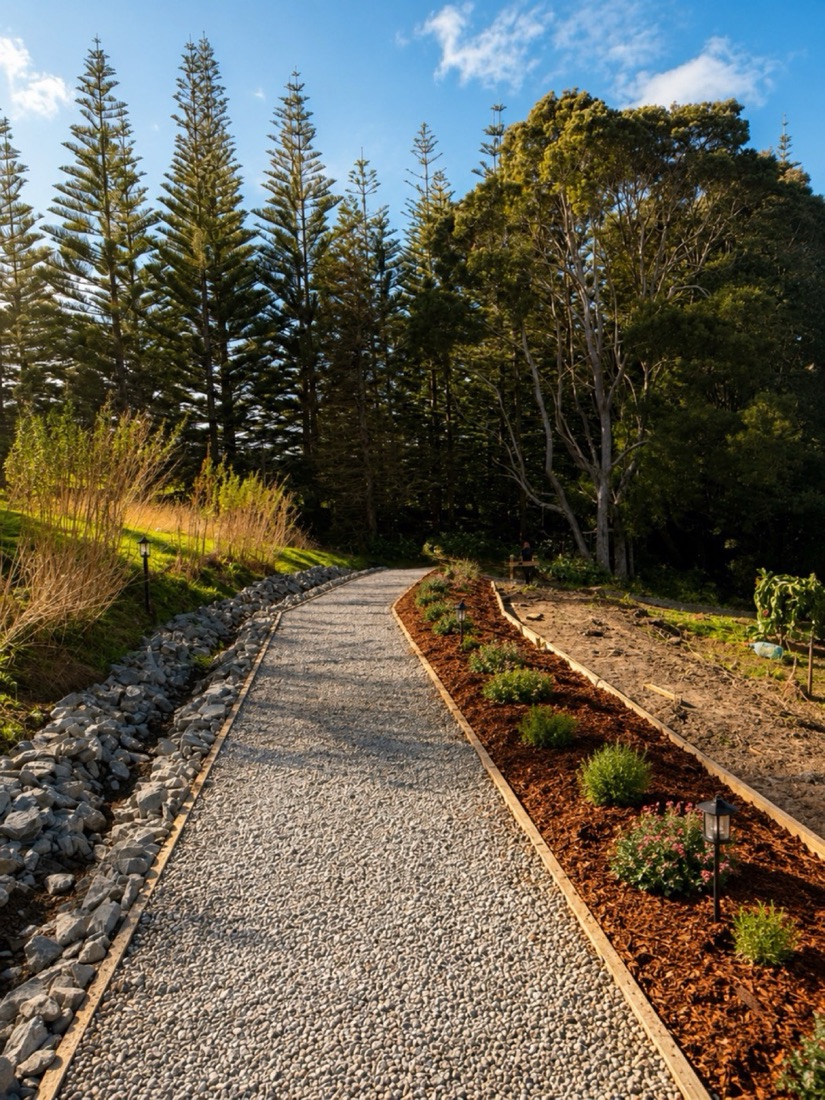
Natural stone appearance
Broadcast aggregate gives the surface a decorative stone look without loose gravel spreading across the site.
 BT Garden LTDLocal Business Since 2018
Resin Surfacing New Zealand
A thin decorative anti-slip stone finish installed over prepared concrete or asphalt. Also searched by Chinese customers as 树脂撒石地坪, 撒石型树脂石, 树脂胶粘石防滑面层, 车道防滑地面 and 车道翻新.
What it is
Resin-bonded surfacing is a thin veneer system where a two-part resin is spread onto a stable prepared substrate, then dry aggregate is immediately broadcast across the wet resin. After curing, excess loose aggregate is removed, leaving a natural resin-bonded gravel appearance and a high-texture surface.
It is different from resin-bound surfacing. Resin-bonded is a resin layer with aggregate cast onto the top. Resin-bound mixes resin and aggregate together before laying and can be designed as a permeable paving system.
Key benefits
Broadcast aggregate gives the surface a decorative stone look without loose gravel spreading across the site.
The exposed aggregate texture can improve grip for driveways, paths and ramps when installed over a suitable base.
Typical resin-bonded systems are thin veneers, often around 1-5 mm depending on aggregate and product system.
For suitable prepared surfaces, installation is generally faster than rebuilding a full driveway structure.
It can refresh existing concrete or asphalt when the substrate is stable, clean and suitable for the expected traffic.
Useful for residential driveways, patios, parking spaces, commercial entrances and pedestrian routes after site assessment.
Many natural aggregate colours may be available, although natural stone can vary between batches.
The bonded finish reduces gravel migration compared with loose gravel, while still needing sweeping and sensible maintenance.
Suitable applications
Decorative stone driveway finish over suitable concrete or asphalt.
Light vehicle areas where the existing base is sound and properly drained.
Outdoor areas needing a cleaner decorative stone surface.
Sites where additional surface texture may help with slip resistance.
Entrance zones where appearance and grip both matter.
Pedestrian routes, garden paths and access walkways on stable substrates.
System build-up
The base must carry the vehicle or pedestrian load. Soft, moving or badly cracked areas need repair first.
The surface is cleaned and prepared so the resin can bond correctly to the substrate.
A compatible resin is spread across the prepared surface within the correct working time.
Dry aggregate is immediately cast to refusal over the wet resin to create the stone texture.
After curing, excess aggregate is removed. Some early loose stone is normal.
Comparison
| Feature | Resin-bonded surfacing | Resin-bound surfacing |
|---|---|---|
| Installation method | Resin is applied first, then dry aggregate is broadcast onto the resin. | Resin and aggregate are mixed together, then trowelled as a combined layer. |
| Typical function | Thin anti-slip and decorative overlay. | Decorative surfacing system that may be designed as permeable. |
| Permeability | Generally not a permeable paving system. | Can be permeable when installed over a suitable permeable build-up. |
| Load support | Load is supported by the concrete or asphalt substrate below. | Also depends on the full pavement build-up and substrate design. |
| Surface look | Textured, broadcast stone look with a more traditional gravel appearance. | Smoother trowelled stone matrix with aggregate mixed throughout. |
Installation process
Check substrate strength, cracks, falls, drainage, access, shade, moisture and intended vehicle use.
Clean, repair and prepare the concrete or asphalt surface according to the selected product system.
Protect edges, drainage channels, walls, doors and nearby surfaces before resin work starts.
Apply the two-part resin evenly while working within the product's open time.
Immediately broadcast dry aggregate to full coverage while the resin is still wet.
Allow curing, remove excess aggregate and confirm the area is ready for use based on product guidance.
Substrate requirements
Important limitations
FAQ
It is a thin decorative and anti-slip surface. Resin is applied to a stable base, then dry aggregate is broadcast over the wet resin.
No. Resin-bonded has aggregate broadcast onto resin. Resin-bound mixes resin and aggregate together before laying.
Yes, if the concrete or asphalt below is strong and stable enough for vehicle use. The substrate carries the load.
Generally no. If permeability is required, a resin-bound permeable system should be considered instead.
It is usually a thin veneer, often around 1-5 mm depending on the product system and aggregate size.
A strong, stable, clean concrete or asphalt surface is required. Cracks, movement and drainage issues must be checked first.
Often yes, if the concrete is sound, clean and suitable. Weak concrete, cracks or poor falls may need repair first.
It can be suitable over prepared asphalt when the surface is stable and compatible with the selected resin system.
Some early loose aggregate is normal and should be swept away after curing. Excessive loss needs checking.
It can help improve surface grip, but the gradient, water flow, substrate and traffic use must be inspected.
Cure time depends on resin type, temperature and site conditions. Use the manufacturer's guidance for foot and vehicle traffic.
Sweep, gently wash when needed, keep drainage clear and inspect worn or damaged areas early.
Resin-bonded driveway quote
Send photos, suburb, approximate area and the current surface type. We will check whether resin-bonded surfacing is suitable before giving a realistic next step.